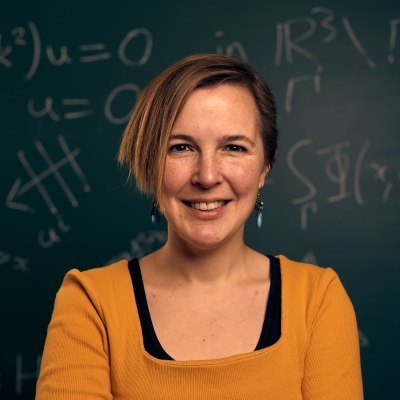
Angelika Manhart
University of Vienna
| angelika.manhart@univie.ac.at | |
| Website | https://angelikamanhart.github.io/ |
| Project Name | modelling heterogeneous cell clusters and their environment (MOHECCE) |
| Publication Page | https://angelikamanhart.github.io/publications.html |
| Field of research | Mathematical Biology |
| Keywords | Mathematical modelling | cell biology | differential equations | agent-based model | collective dynamics | numerical simulations | cancer cells |
I am an Associate Professor in Mathematical Biology at the University of Vienna. Having a passion for both subjects, I have studied both Mathematics and Molecular Biology at the University of Vienna. My academic journey then led me to the Courant Institute at New York University and Imperial College London. I became an Assistant Professor at University College London in 2019. After this I “completed the circle” by moving back to Vienna in 2023 as an Assistant Professor for Mathematical Biology. At the end of 2025 I became Associate Professor.
My other passions are my two kids and art.
In my research I derive, analyse and simulate mathematical models of cell biological phenomena, such as the dynamics of cell collectives, self-organisation of cell organelles or cell migration. This typically involved collaborations with experimentalists and working with them and their data. The models are often based on differential equations and the tools to understand them range from analytical tools to simulating them.
I like sharing and discussing science with the interested public, where I also always learn something new!
Project: Modelling heterogeneous cell clusters and their environment (MOHECCE)
In my ASTRA project we will use mathematical modelling to build a thorough theoretical understanding of cell cluster migration. Guiding questions are:
1. How do cells self-organise into clusters and what influences cluster formation and behaviour?
2. What are the differences/benefits of moving as a cluster compared to moving as single cells?
The project will focus on two key aspects: The impacts of cell state heterogeneity and a cluster’s environment. The obtained insights will be validated by and applied to experimental data with a focus on cancer metastasis.